Kapitel 3: Vektorräume (Grundidee)

3.1 Begriff des Vektorraums

Ein Vektorraum ist eine Menge von Objekten (genannt Vektoren), auf der zwei Operationen definiert sind — Addition und Skalarmultiplikation — die bestimmten Rechenregeln genügen.

Definition: Vektorraum

Eine Menge VV mit einer Addition +:V×VV+: V \times V \to V und einer Skalarmultiplikation :×VV\cdot: \mathbb{R} \times V \to V heißt reeller Vektorraum, wenn für alle 𝐮,𝐯,𝐰V\mathbf{u}, \mathbf{v}, \mathbf{w} \in V und c,dc, d \in \mathbb{R} gilt:

  1. 𝐮+𝐯=𝐯+𝐮\mathbf{u} + \mathbf{v} = \mathbf{v} + \mathbf{u} (Kommutativität)
  2. (𝐮+𝐯)+𝐰=𝐮+(𝐯+𝐰)(\mathbf{u} + \mathbf{v}) + \mathbf{w} = \mathbf{u} + (\mathbf{v} + \mathbf{w}) (Assoziativität)
  3. Es gibt ein neutrales Element 𝟎V\mathbf{0} \in V mit 𝐯+𝟎=𝐯\mathbf{v} + \mathbf{0} = \mathbf{v}
  4. Zu jedem 𝐯\mathbf{v} gibt es ein 𝐯-\mathbf{v} mit 𝐯+(𝐯)=𝟎\mathbf{v} + (-\mathbf{v}) = \mathbf{0}
  5. c(𝐮+𝐯)=c𝐮+c𝐯c(\mathbf{u} + \mathbf{v}) = c\mathbf{u} + c\mathbf{v}
  6. (c+d)𝐯=c𝐯+d𝐯(c + d)\mathbf{v} = c\mathbf{v} + d\mathbf{v}
  7. (cd)𝐯=c(d𝐯)(cd)\mathbf{v} = c(d\mathbf{v})
  8. 1𝐯=𝐯1 \cdot \mathbf{v} = \mathbf{v}
Beispiel

n\mathbb{R}^n mit komponentenweiser Addition und Skalarmultiplikation ist der grundlegendste reelle Vektorraum. Alle acht Axiome lassen sich direkt anhand der Komponentenrechnung nachprüfen.

Übung

Überprüfe die Axiome 3 und 4 für 2\mathbb{R}^2: Welches Element spielt die Rolle von 𝟎\mathbf{0}, und wie sieht 𝐯-\mathbf{v} für 𝐯=(25)\mathbf{v} = \begin{pmatrix} 2 \\ -5 \end{pmatrix} aus?


3.2 Beispiele von Vektorräumen

Beispiel

Folgende Mengen sind reelle Vektorräume:

  • n\mathbb{R}^n mit komponentenweiser Addition und Skalarmultiplikation
  • m×n\mathbb{R}^{m \times n}, die Menge aller m×nm \times n-Matrizen
  • 𝒫n\mathcal{P}_n, die Menge aller Polynome vom Grad n\leq n, z. B. p(x)=3x2x+2p(x) = 3x^2 - x + 2
  • C([a,b])C([a,b]), die Menge aller stetigen Funktionen auf [a,b][a,b]
Übung

Ist die Menge M={(x,y)2x0}M = \{ (x, y) \in \mathbb{R}^2 \mid x \geq 0 \} ein Vektorraum? Begründe deine Antwort anhand der Axiome.


3.3 Unterräume

Definition: Unterraum

Eine nicht-leere Teilmenge UVU \subseteq V heißt Unterraum von VV, wenn:

  1. 𝟎U\mathbf{0} \in U
  2. 𝐮,𝐯U𝐮+𝐯U\mathbf{u}, \mathbf{v} \in U \Rightarrow \mathbf{u} + \mathbf{v} \in U (abgeschlossen unter Addition)
  3. 𝐮U,cc𝐮U\mathbf{u} \in U, c \in \mathbb{R} \Rightarrow c\mathbf{u} \in U (abgeschlossen unter Skalarmultiplikation)
Beispiel

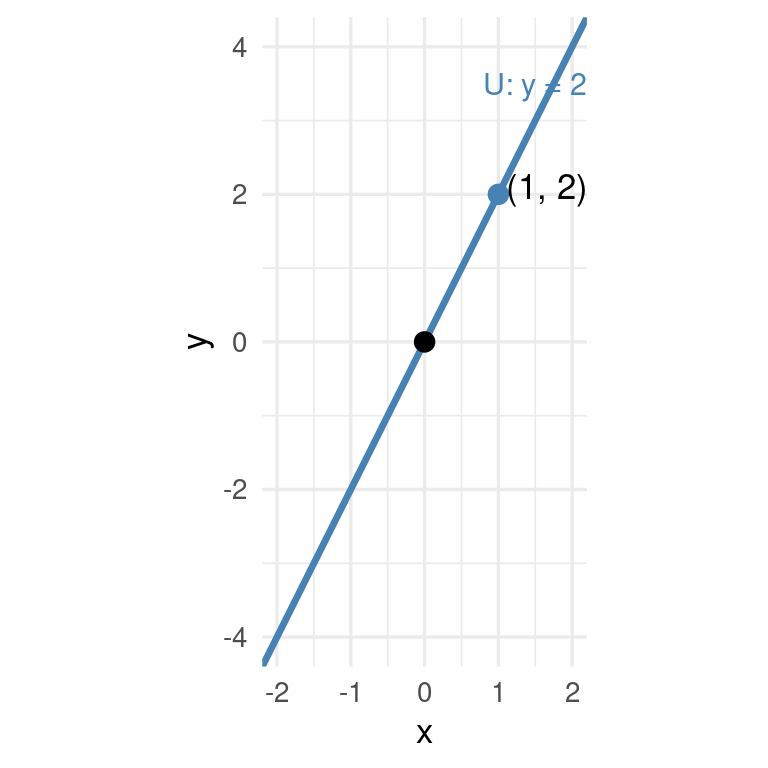
Die Menge U={(x,y)2y=2x}U = \{ (x, y) \in \mathbb{R}^2 \mid y = 2x \} ist ein Unterraum von 2\mathbb{R}^2: Sie enthält 𝟎=(0,0)\mathbf{0} = (0,0), ist abgeschlossen unter Addition und Skalarmultiplikation. Geometrisch ist UU eine Gerade durch den Ursprung.

Übung

Ist W={(x,y)2y=2x+1}W = \{ (x, y) \in \mathbb{R}^2 \mid y = 2x + 1 \} ein Unterraum von 2\mathbb{R}^2? Prüfe alle drei Bedingungen.


3.4 Lineare Unabhängigkeit

Definition: Lineare Unabhängigkeit

Vektoren 𝐯1,,𝐯kV\mathbf{v}_1, \ldots, \mathbf{v}_k \in V heißen linear unabhängig, wenn aus c1𝐯1+c2𝐯2++ck𝐯k=𝟎c_1 \mathbf{v}_1 + c_2 \mathbf{v}_2 + \cdots + c_k \mathbf{v}_k = \mathbf{0} folgt, dass c1=c2==ck=0c_1 = c_2 = \cdots = c_k = 0. Andernfalls heißen sie linear abhängig.

Beispiel

Die Vektoren 𝐯1=(10)\mathbf{v}_1 = \begin{pmatrix} 1 \\ 0 \end{pmatrix} und 𝐯2=(01)\mathbf{v}_2 = \begin{pmatrix} 0 \\ 1 \end{pmatrix} sind linear unabhängig: Aus c1𝐯1+c2𝐯2=𝟎c_1 \mathbf{v}_1 + c_2 \mathbf{v}_2 = \mathbf{0} folgt (c1c2)=(00)\begin{pmatrix} c_1 \\ c_2 \end{pmatrix} = \begin{pmatrix} 0 \\ 0 \end{pmatrix}, also c1=c2=0c_1 = c_2 = 0.

Dagegen sind 𝐮1=(12)\mathbf{u}_1 = \begin{pmatrix} 1 \\ 2 \end{pmatrix} und 𝐮2=(24)\mathbf{u}_2 = \begin{pmatrix} 2 \\ 4 \end{pmatrix} linear abhängig, da 2𝐮1𝐮2=𝟎2\mathbf{u}_1 - \mathbf{u}_2 = \mathbf{0}.

Übung

Sind 𝐯1=(120)\mathbf{v}_1 = \begin{pmatrix} 1 \\ 2 \\ 0 \end{pmatrix}, 𝐯2=(013)\mathbf{v}_2 = \begin{pmatrix} 0 \\ 1 \\ 3 \end{pmatrix}, 𝐯3=(233)\mathbf{v}_3 = \begin{pmatrix} 2 \\ 3 \\ -3 \end{pmatrix} linear unabhängig? Stelle das Gleichungssystem c1𝐯1+c2𝐯2+c3𝐯3=𝟎c_1\mathbf{v}_1 + c_2\mathbf{v}_2 + c_3\mathbf{v}_3 = \mathbf{0} auf und löse es.