Kapitel 5: Operationen mit Matrizen

5.1 Matrixaddition

Definition: Matrixaddition

Seien A,Bm×nA, B \in \mathbb{R}^{m \times n}. Die Summe A+Bm×nA + B \in \mathbb{R}^{m \times n} ist komponentenweise definiert: (A+B)ij=aij+bij(A + B)_{ij} = a_{ij} + b_{ij} Addition ist nur für Matrizen gleicher Dimension definiert.

Beispiel

(1230)+(1423)=(0653)\begin{pmatrix} 1 & 2 \\ 3 & 0 \end{pmatrix} + \begin{pmatrix} -1 & 4 \\ 2 & -3 \end{pmatrix} = \begin{pmatrix} 0 & 6 \\ 5 & -3 \end{pmatrix}

Übung

Berechne A+BA + B für A=(412035)A = \begin{pmatrix} 4 & -1 & 2 \\ 0 & 3 & -5 \end{pmatrix} und B=(210134)B = \begin{pmatrix} -2 & 1 & 0 \\ 1 & -3 & 4 \end{pmatrix}.


5.2 Skalarmultiplikation

Definition: Skalarmultiplikation

Sei cc \in \mathbb{R} und Am×nA \in \mathbb{R}^{m \times n}. Das skalare Vielfache cAm×ncA \in \mathbb{R}^{m \times n} ist: (cA)ij=caij(cA)_{ij} = c \cdot a_{ij}

Beispiel

3(2104)=(63012)3 \cdot \begin{pmatrix} 2 & -1 \\ 0 & 4 \end{pmatrix} = \begin{pmatrix} 6 & -3 \\ 0 & 12 \end{pmatrix}

Übung

Berechne 2A-2A für A=(153024)A = \begin{pmatrix} 1 & 5 \\ -3 & 0 \\ 2 & -4 \end{pmatrix}.


5.3 Matrixmultiplikation

Definition: Matrixmultiplikation

Seien Am×kA \in \mathbb{R}^{m \times k} und Bk×nB \in \mathbb{R}^{k \times n}. Das Produkt ABm×nAB \in \mathbb{R}^{m \times n} ist definiert durch: (AB)ij=l=1kailblj(AB)_{ij} = \sum_{l=1}^{k} a_{il} \cdot b_{lj} Das Produkt ist nur definiert, wenn die Spaltenzahl von AA gleich der Zeilenzahl von BB ist.

Beispiel

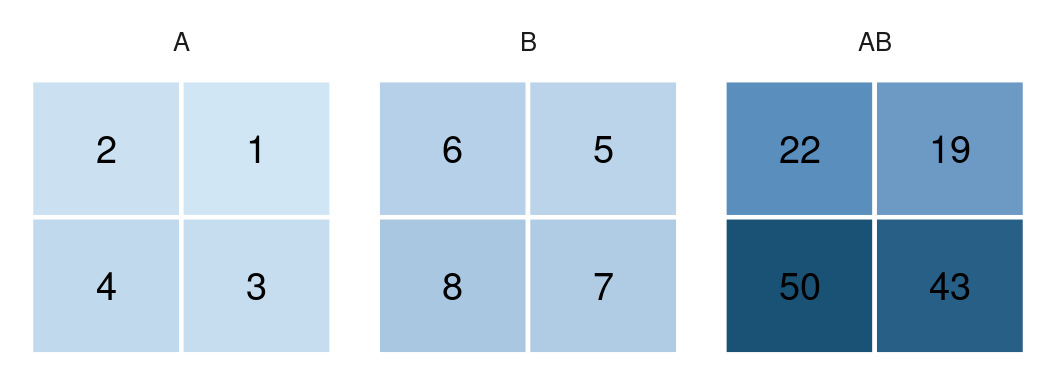
(1234)(5678)=(15+2716+2835+4736+48)=(19224350)\begin{pmatrix} 1 & 2 \\ 3 & 4 \end{pmatrix} \begin{pmatrix} 5 & 6 \\ 7 & 8 \end{pmatrix} = \begin{pmatrix} 1\cdot5 + 2\cdot7 & 1\cdot6 + 2\cdot8 \\ 3\cdot5 + 4\cdot7 & 3\cdot6 + 4\cdot8 \end{pmatrix} = \begin{pmatrix} 19 & 22 \\ 43 & 50 \end{pmatrix}

Wichtig: Matrixmultiplikation ist im Allgemeinen nicht kommutativ: ABBAAB \neq BA.

Übung

Berechne ABAB und BABA für A=(1023)A = \begin{pmatrix} 1 & 0 \\ 2 & 3 \end{pmatrix} und B=(4102)B = \begin{pmatrix} 4 & 1 \\ 0 & 2 \end{pmatrix}. Sind die Ergebnisse gleich?


5.4 Transponierte Matrix

Definition: Transponierte

Die Transponierte An×mA^\top \in \mathbb{R}^{n \times m} einer Matrix Am×nA \in \mathbb{R}^{m \times n} entsteht durch Vertauschen von Zeilen und Spalten: (A)ij=aji(A^\top)_{ij} = a_{ji}

Beispiel

A=(123456)2×3A=(142536)3×2A = \begin{pmatrix} 1 & 2 & 3 \\ 4 & 5 & 6 \end{pmatrix} \in \mathbb{R}^{2 \times 3} \implies A^\top = \begin{pmatrix} 1 & 4 \\ 2 & 5 \\ 3 & 6 \end{pmatrix} \in \mathbb{R}^{3 \times 2}

Eine quadratische Matrix mit A=AA = A^\top heißt symmetrisch, z. B.: S=(1332)S = \begin{pmatrix} 1 & 3 \\ 3 & 2 \end{pmatrix}

Übung

Bestimme BB^\top für B=(014235106)B = \begin{pmatrix} 0 & -1 & 4 \\ 2 & 3 & -5 \\ 1 & 0 & 6 \end{pmatrix} und prüfe, ob BB symmetrisch ist.